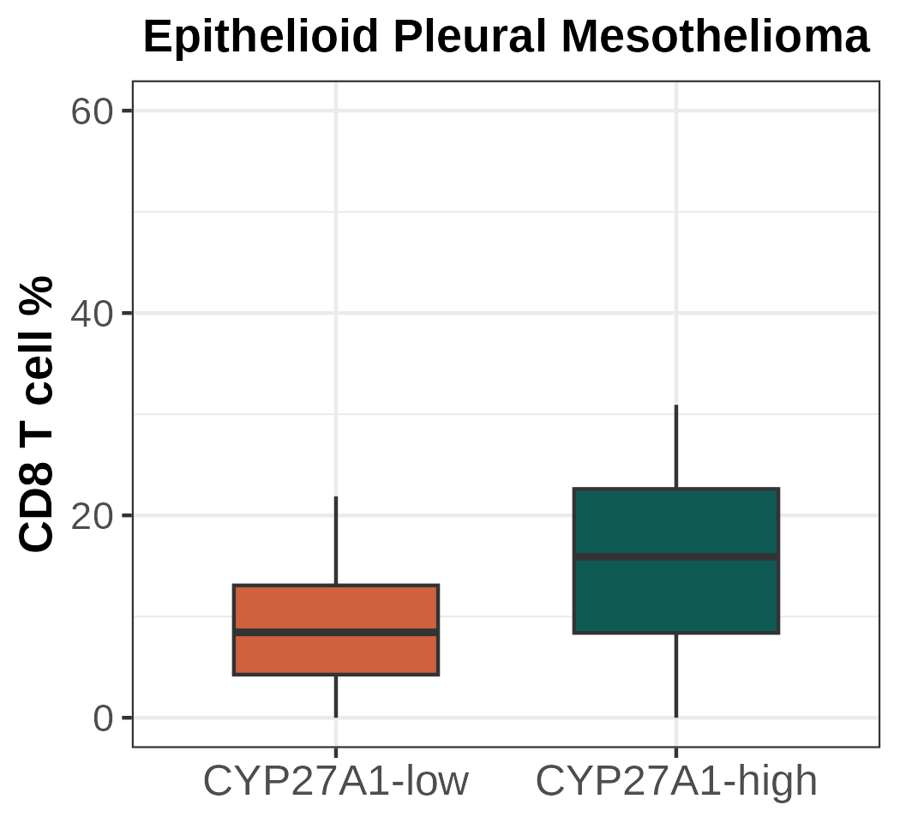
CYP27A1
A known marker of favorable prognosis in mesothelioma, not yet explained. SMART proposes a potential explanation: T cell infiltration.
AI agents test published findings in new data.
121 papers · 6 cancers · 726 automated tests
Proven in lung. Overlooked in mine?
Few studies in my cancer? Borrow from richly studied ones.
Which cancer is mine most like? Not the one you would guess.
Pieces from separate papers. A new mechanism for mine.
One gene, every cancer. What holds in mine?
A whole mechanism from one paper. Does it hold in mine?
Every paper adds a piece. What do they build together?
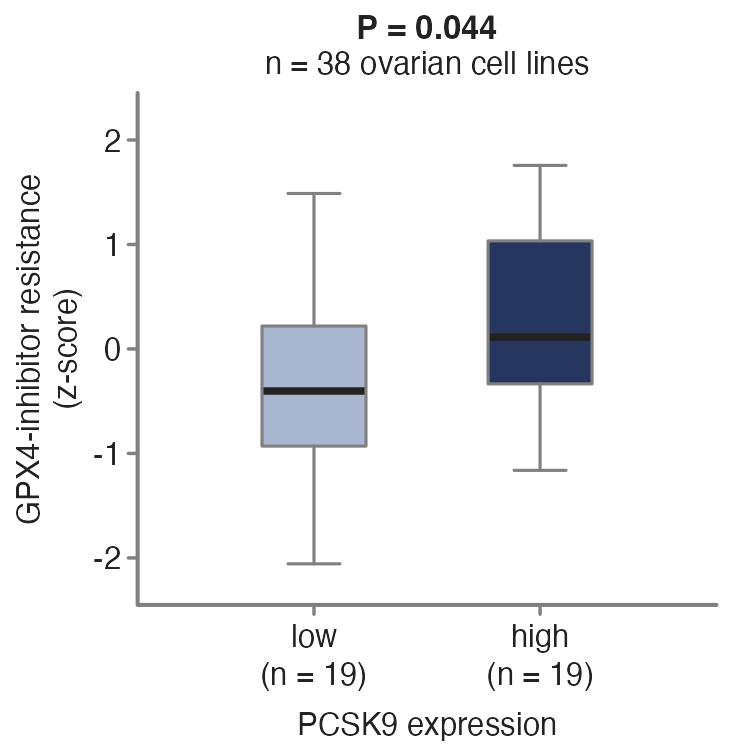
GPX4 inhibitors for PCSK9-low ovarian cancer
P = 0.044 · 38 cell linesEvery lab does discovery transfer by hand: take a finding from a paper and check whether it holds in new data. Most findings are never tested outside their original setting. SMART gives the task to AI agents, so every finding can be tested everywhere.
Each month, gather new single-cell cancer studies from Nature Portfolio journals across six cancer types.
Extract each paper’s clinical findings and mechanistic claims, then check every claim against the paper’s text and figures.
Check whether the target dataset can test each claim, write and run the analysis, and report whether it holds, differs, or fails.
Results go into cancer-wiki: the cancer-connection map and the glioblastoma mechanism network.
Each of 121 source studies was tested in six target datasets (726 reports). Averaging by source cancer gives the share of reports that transfer from each source (row) to each target (column).
Ovarian findings transfer into pancreatic cancer more than any other source’s (67%), and pancreatic findings transfer into ovarian cancer more than any other source’s (60%). No other pair ranks first in both directions.
A surprising pair. So why?
Ranked against pancreatic cancer, ovarian cancer is fourth by developmental origin but first by transfer.
All eight lipid-metabolism and fibroblast studies transfer between the pair, against at most 50% into the other cancers. Tumor cell-intrinsic findings mostly do not.
| OVA ↔ PANC | CRC | GBM | LIVER | LUNG | |
|---|---|---|---|---|---|
| Lipid metabolism (4) | 100% | 50% | 25% | 50% | 25% |
| Fibroblasts, CAF (4) | 100% | 50% | 0% | 0% | 50% |
| Immune environment (7) | 71% | 43% | 71% | 29% | 71% |
| Tumor cell-intrinsic (12) | 33% | 50% | 67% | 50% | 17% |
Share of the 27 ovarian and pancreatic studies that transfer, by topic (number of studies in brackets).
From pancreatic cancer: PCSK9-high cells are more resistant to GPX4 inhibitors. SMART found the mechanism transfers to ovarian cancer, where PCSK9-high cells show higher cholesterol biosynthesis.
Independent check: among 38 ovarian cancer cell lines in CTRP, PCSK9-high lines are more resistant to GPX4 inhibitors (P = 0.044).
Pleural mesothelioma is aggressive, asbestos-linked and has few studies of its own. Instead of waiting for its own literature, SMART tested all 121 source papers from six well-studied cancers against one mesothelioma single-cell dataset.
A known marker of favorable prognosis in mesothelioma, not yet explained. SMART proposes a potential explanation: T cell infiltration.
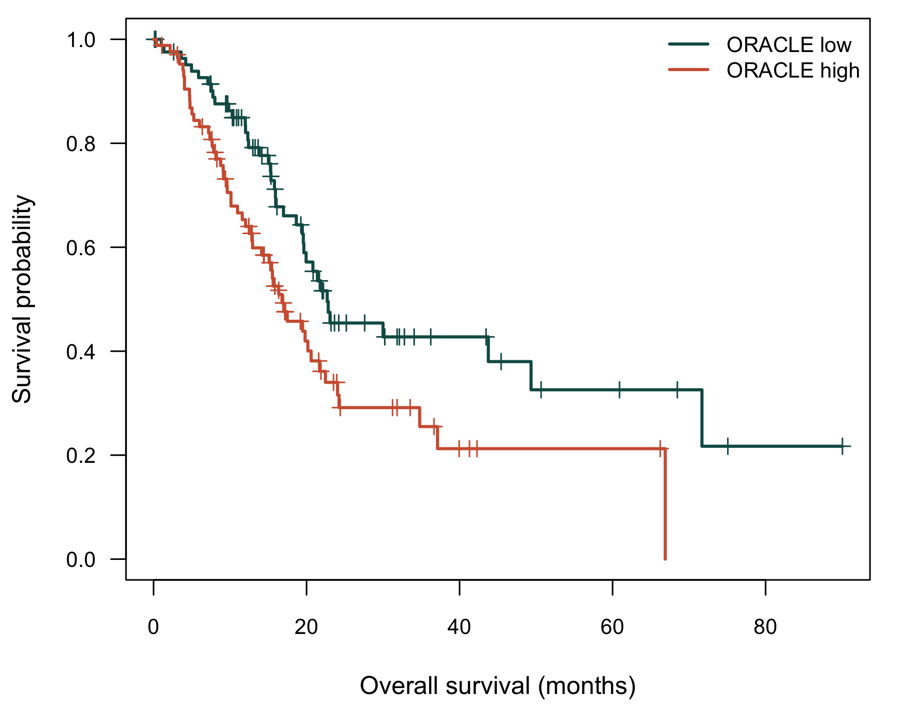
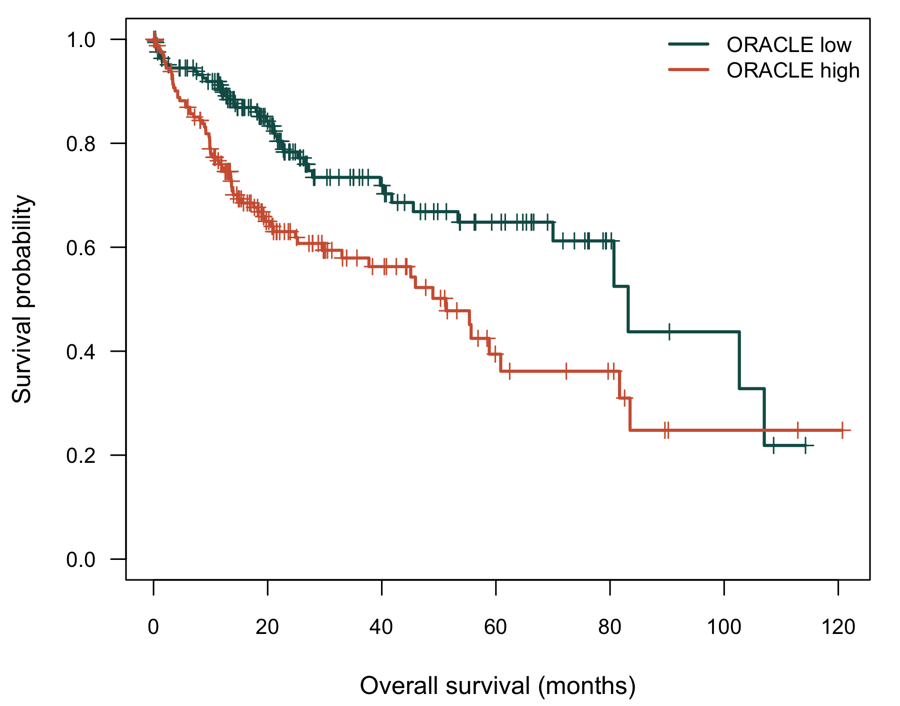
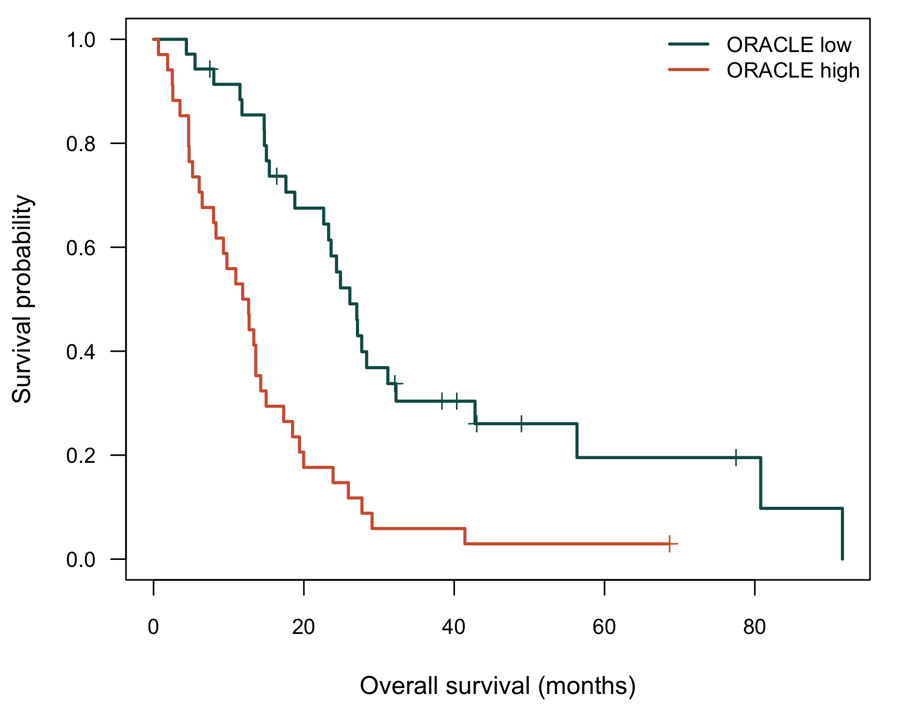
In TCGA-MESO, patients with high ORACLE scores have worse survival.
Claims from papers on five other cancers that hold in glioblastoma data, joined wherever two claims share a gene or cell state. Drag to rotate, click a node for its claims, or start the guided tour.
The network and its claims are released under CC BY-NC 4.0: free for research use with credit. Please cite our paper when you use them.
216 claims that hold in glioblastoma, forming 206 unique links. Each comes from a published paper on another cancer.
The same machinery answers a range of everyday questions, depending on what you point it at.
Is this paper worth my time?
Before committing bench work to a finding from a paper, see which of its claims survive in your own data. Point one paper at your dataset.
Where does my system differ from theirs?
A claim that fails is as informative as one that holds. It marks where two settings genuinely diverge. Read the negatives, not just the positives.
Does this signature work in my cancer?
Prognostic signatures built in one tumour type can retain value in others that nobody thought to check. Test it outside its home cancer.
My cancer barely has a literature.
Borrow systematically from the well-studied ones instead of by hand. Point many papers at one dataset.
What’s already known about this gene here?
Claims about one gene are scattered across papers in different cancers. Collect the ones that still hold in your data. Group tested claims by gene.
I need a hypothesis narrow enough to test.
Join claims from separate papers into a chain, then test only the link nobody has reported. Assemble across reports.
That question is easy to ask and slow to answer. You read the paper, work out what it actually claims, decide which of those claims your dataset could speak to, write the analyses, run them, and read the output. None of it is hard. Doing it for every paper worth checking is what makes it impossible.
SMART does that for you. It takes the paper’s mechanism, tests each claim in it against your data, and reports which ones held.
| Module | What it does |
|---|---|
| Results Extraction | Works out what the study actually claimed, checks it against the paper’s own figures and text, and pins down what each biological term means in single-cell terms. |
| Data Inspection | Describes your dataset as it is: the cell types present, every metadata field, and what can be measured. |
| Transferability | Decides whether this mechanism can be tested here at all. If it cannot, the run stops rather than spending compute on a pairing the data cannot speak to. |
| Task Plan | Decides which claims are testable in your data and exactly which analysis tests each one, with real parameters read from your dataset. |
| Code & Analyze | Writes and runs the analysis, debugging the run until it completes. |
| Report | Decides whether each claim held, what contradicts the paper, what is new, and what to do next. |
The repository has the full instructions for the 20 agents and how to run them directly as a workflow.
We host:
Vote for what you want next, or suggest your own.
We host hot papers, with summaries and designed tests you can reuse, and gold-standard datasets, with notes on how to use them well. Vote for the papers and datasets you want next, or suggest your own. Discovery transfer is not limited to cancer, so you can also vote for the next field to apply it to.
Votes are anonymous: one per item per browser. New suggestions appear right away, marked new, and are reviewed weekly.
Tens of thousands of cancer papers appear every year. Most findings are tested once, in the setting they came from, then cited and left behind. The field produces results far faster than it connects them.
A mechanism found in lung may explain an outcome in liver. A signature built for one cancer may predict survival in another. A finding gains value every time it is tested somewhere new, and every test, whether it holds or fails, tells us something about both cancers.
Mapping every finding against every other cancer means reading, extracting, testing and reporting far more times than any lab or consortium could by hand. Agents can, systematically and with every step on record.
Not to replace investigators, but to make sure no finding goes unused. Let agents map the literature onto itself, and let people choose which leads to pursue.
Treat published results as a shared map that agents keep testing and connecting. Share your papers and datasets, state your mechanisms in a form agents can read, and help decide what gets tested next.
Want to apply the same logic beyond cancer? We will actively expand SMART to new fields, so tell us where it should go next.
Cancer research publishes tens of thousands of papers a year, and almost every finding is tested only where it was found. cancer-wiki tests them elsewhere, automatically, and keeps every claim that transfers.
Built with SMART, our AI agent system for agentic discovery transfer. Glioblastoma is the first full target; each release adds papers and cancers.
Cheng L.*, Shireman J.*, Gogate A., Stangis M., Cai Y., Xie Y., Khatri P., Dey M., Kendziorski C. Agentic Discovery Transfer Enables Cross-Cancer Discovery at Scale. bioRxiv (2026). doi:10.64898/2026.10.28.762506
*These authors contributed equally.
cancer-wiki data are released under CC BY-NC 4.0: free to use and share with credit, not for commercial use.